Seeds and output counts
A seed identifies a random stream. It is useful for replay and nearby exploration; it is not a portable quality score.
Seed plans
SeedPlan.scout(count)derives a documented set of independent seeds for a broad first pass.SeedPlan.locked(seed)preserves one seed for a controlled run. The Python API can repeat it, but identical requests can produce duplicate candidates; Studio therefore pairs Locked mode with one output.SeedPlan.explicit([...])uses caller-provided seeds exactly.
Every candidate records the actual integer used. A backend must not share one mutable generator across a batch and then describe the batch as independently seeded.
Choose an output count
| Count | Use it when | Trade-off |
|---|---|---|
| 1 | checking a recipe or device | fastest, no meaningful comparison |
| 4 | normal scouting and variation | useful balance of breadth and cost |
| 8 | a direction is still ambiguous | broader but slower and harder to review |
The Simple view exposes 1, 4, and 8 and defaults to one quick proof. Advanced exposes the same counts so the contact sheet and review flow remain predictable.
A useful designer loop
- Scout four independent seeds with Balanced structure.
- Pick on concept, not on a technical badge alone.
- Vary the selected candidate with a structure lock and subtle strength.
- Change one recipe dimension at a time when comparing runs.
- Export before starting a materially different direction.
Do not publish a “recommended seeds” list as if the numbers generalize across models, prompts, schedulers, or inputs. Publish the complete recipe and result lineage instead.
A real heritage-seed check
The
AWS Korea 2023 Coding School notebook at main@4b3a220
recorded 6764547109648557242 as its active first-exercise seed. Its same code
cell preserved 6854547109648557242 and 6634547109688557242 in comments,
alongside 40 steps, CFG 7, and Canny thresholds 140/160. AIsketcher 0.2 reran
all three numbers against the current pinned SDXL Canny Lite recipe. It used
the already installed cache in offline mode, so the comparison downloaded zero
bytes.
The notebook contains two prompt records that should not be conflated. Its
opening lesson text proposes 알파벳 A, 글자, 추상화, 멋진 펜아트; the saved
stdout for the active-seed execution records 특이한 풍경, 환상적인 그림, 복잡한
나라, 귀여운 케릭터. The provenance file preserves both as the documented brief
and recorded runtime prompt, respectively.
Only the three numeric seeds were carried into the v2 compatibility run. The input, prompt, model stack, and generation recipe deliberately changed:
| Dimension | 2023 notebook evidence | AIsketcher 0.2 compatibility run |
|---|---|---|
| Source | present_image1.jpeg |
reviewed metadata-free Pocket Kingdom source |
| Prompt | saved Korean runtime prompt above | expanded English graphic-design prompt |
| Base / ControlNet | DreamShaper / SD Canny, revisions unpinned | SDXL Base / SDXL Canny Small, revisions pinned |
| Scheduler | PNDM | UniPC |
| Steps / CFG | 40 / 7 | 24 / 5.5 |
| Canny low / high | 140 / 160 | 90 / 224 |
This is a seed-compatibility study, not a claim that v2 reproduces the complete 2023 recipe or its pixels.
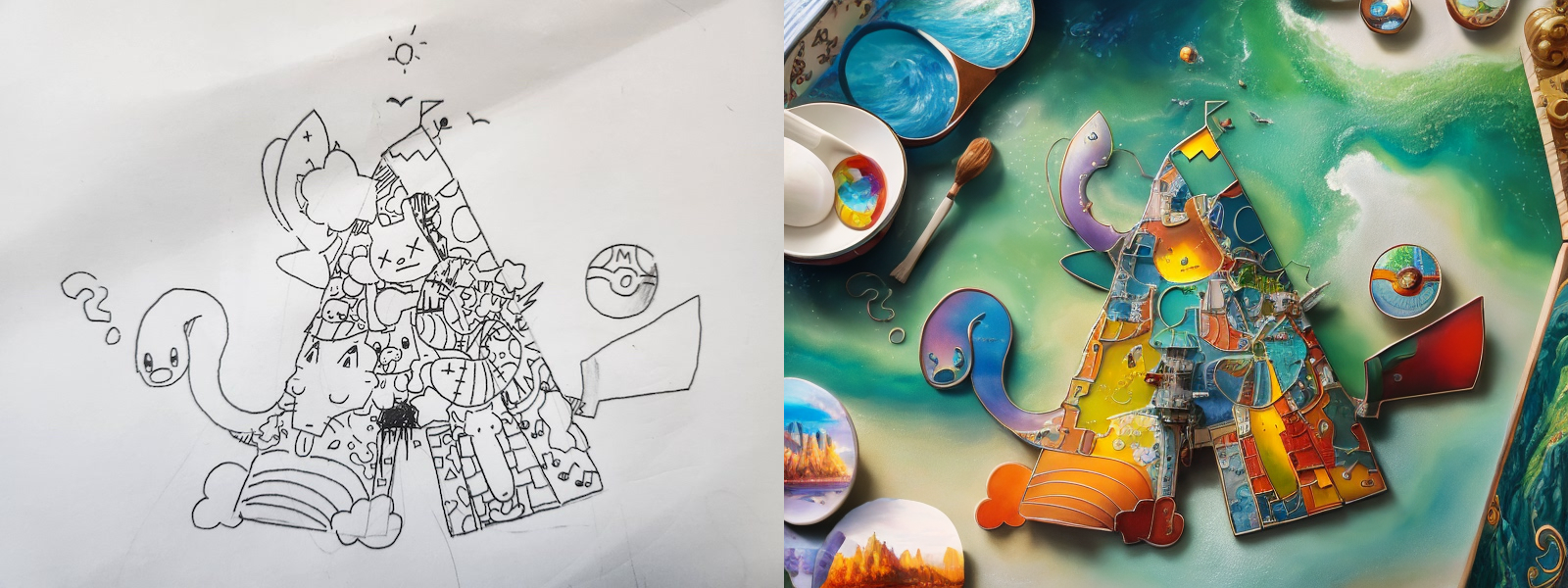
6764547109648557242 · 40 steps · CFG 7 · Canny 140/160.
This is the image embedded in that execution cell, not the separate showcase
JPEG.
The legacy stack did not pin model revisions, so this evidence is preserved as a historical result rather than promised as a pixel-identical v2 replay.
2026 Studio hero interpretation
The English Studio documentation uses a separate, visually directed v2 study.
Its selected first direction keeps the exact active seed
6764547109648557242; the model, prompt, and rendering recipe are deliberately
modern. The English prompt is a human-written synthesis of the lesson brief and
saved runtime prompt, not a claimed recovery of the old AWS translation.
| Setting | Studio hero study |
|---|---|
| Preset | pinned sdxl-canny-lite@1 |
| Outputs | 4 explicit seeds; no random seed |
| Selected seed | 6764547109648557242 |
| Steps / CFG | 36 / 7.0 |
| Canny low / high | 140 / 160 |
| Control strength | 0.55 |
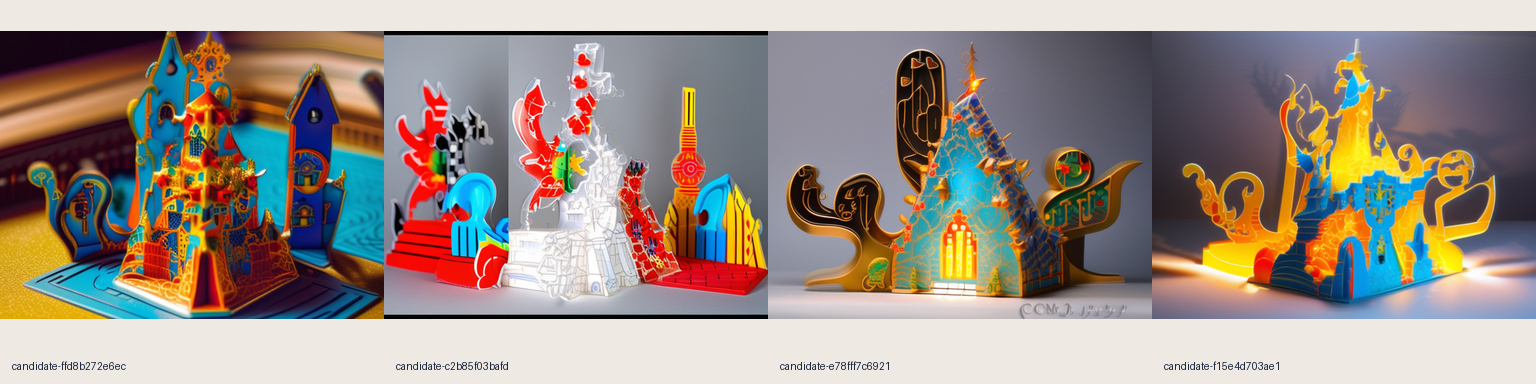
The complete manifest and HPO provenance preserve the prompt, negative prompt, model revisions, runtime, settings, seeds, and artifact hashes.
AIsketcher 0.2 separately reran the three notebook values with its current pinned recipe. The current images are retained as compatibility evidence, not as a visual recommendation:
Open the current v2 compatibility contact sheet
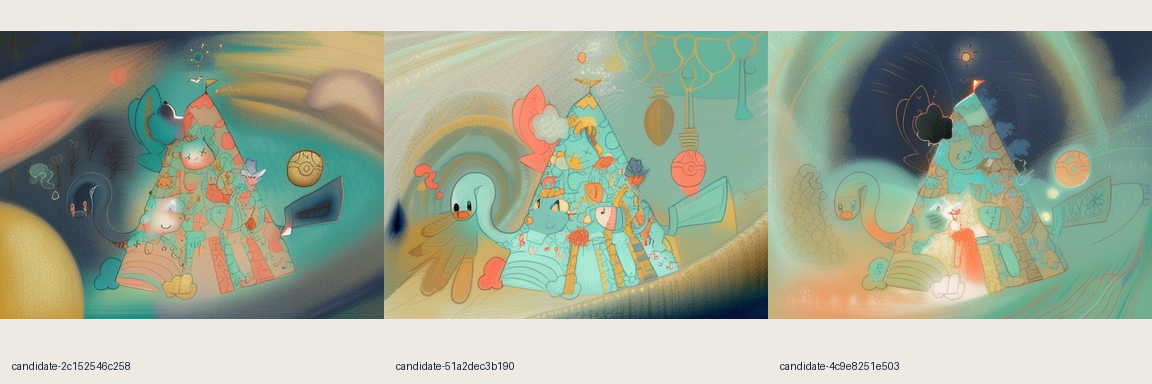
| Seed | Structure | Edge cleanliness | Distinctiveness | Review |
|---|---|---|---|---|
6764547109648557242 |
0.271662 | 0.616346 | 0.194801 | exact recorded active seed |
6854547109648557242 |
0.322524 | 0.811936 | 0.198649 | three technical badges; not an aesthetic selection |
6634547109688557242 |
0.181476 | 0.373457 | 0.187767 | third comparison direction |
The center seed scored higher on all three automated diagnostics for this run, but those diagnostics do not decide what is beautiful. The exact active 2023 seed remains the canonical reference. The important result is that the old number was accepted exactly as a 63-bit seed and the new execution produced a fresh manifest with pinned model revisions and artifact hashes.
The legacy input JPEG was not copied because it contains camera and GPS EXIF. The current study uses the reviewed metadata-free source. The separate legacy showcase JPEG is not claimed as the recorded seed's output; the embedded cell image above is the verified execution evidence. See the bundle's provenance contract.